

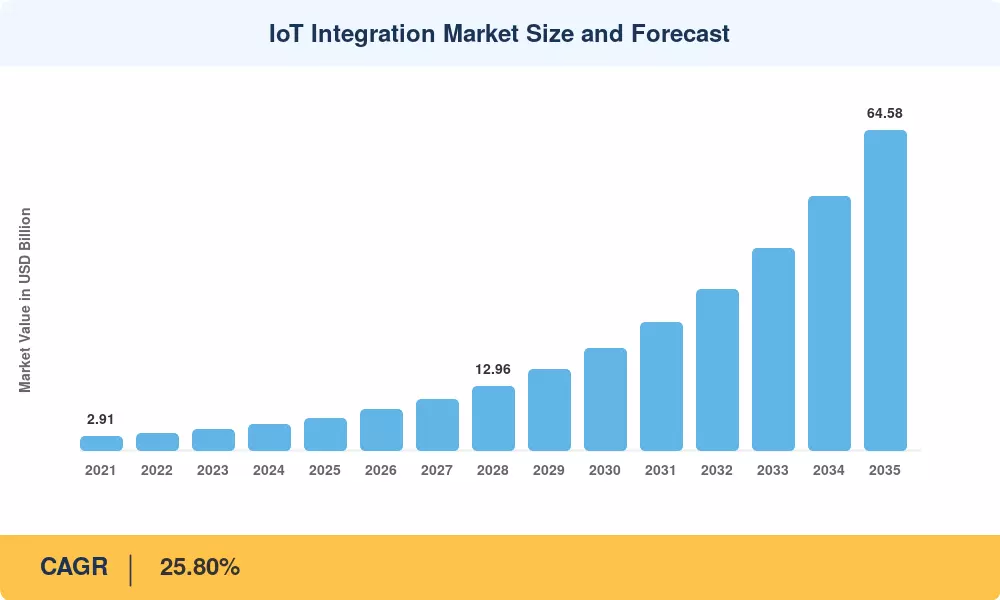
IoT Integration Market Trends Point to USD 64.58 Billion Value with 25.80% CAGR by 2035
IoT Integration Market
IoT Integration Market connects devices, applications, and data platforms to improve automation, analytics, and operational efficiency.
IoT integration transforms connected devices into intelligent ecosystems, enabling seamless communication, real-time insights, and smarter business decisions.”
ONTARIO, ONTARIO, CANADA, July 30, 2026 /EINPresswire.com/ -- Connecting a sensor to the internet has never been the hard part. Making that sensor talk reliably to a dozen other systems legacy SCADA controllers, cloud analytics platforms, mobile apps, and everything in between is where most IoT projects stall. IoT integration has emerged as the specialised discipline that bridges this gap, weaving device management, network orchestration, and application-layer analytics into a single, coherent control plane rather than a patchwork of point-to-point connections that break whenever a new device type is added.— Market Research Future
The global IoT Integration Market reached USD 6.50 Billion in 2025 and is forecast to grow from USD 8.18 Billion in 2026 to USD 64.58 Billion by 2035, registering a 25.80% CAGR across the forecast window. Accelerating 5G rollouts and enterprise digital-transformation mandates, the U.S. CHIPS and Science Act alone earmarked over USD 52 billion for semiconductor and connected-infrastructure programs, channelling investment toward integration specialists capable of bridging multi-vendor IoT ecosystems. Governments in the EU, India, and South Korea have concurrently launched smart-city and Industry 4.0 frameworks that explicitly require certified integration partners to manage cross-platform deployments.
Legacy point-to-point interfaces are making way for cloud-native orchestration layers and edge-computing fabrics that bring sensors, gateways, and analytics pipelines together into a single control plane. The World Economic Forum projects that by 2027, the number of IoT devices globally will exceed 30 billion, a scale that will overwhelm ad hoc integration methods and push organisations decisively toward managed integration services rather than in-house, one-off builds.
Get a Sample PDF of the Report at --
https://www.marketresearchfuture.com/sample_request/7312
Market Dynamics: Drivers, Restraints and Opportunities
5G and private-network proliferation is reshaping the IoT Integration Market by enabling ultra-reliable, low-latency communication channels that legacy 4G simply could not support. Global 5G connections are forecast to reach 5.6 billion by 2030, with enterprises representing the fastest-growing subscriber segment, and private 5G spectrum allocations in Germany and Japan have already unlocked factory-floor IoT projects requiring deterministic networking. Edge-cloud architecture adoption is compounding this momentum, as the share of enterprise IoT data processed at the edge is expected to climb sharply by 2028, dramatically expanding the scope of integration engagements that now require specialized middleware and data-synchronization services to keep distributed environments consistent.
Enterprise digital-transformation programs are a further major catalyst, with global spending on digital transformation crossing USD 2.3 trillion in 2024 and IoT integration services capturing a growing share of implementation budgets, particularly in manufacturing, logistics, and retail as these sectors chase real-time supply-chain visibility. AI and machine-learning integration into IoT pipelines is adding an entirely new service layer as well, with integrators increasingly offering MLOps pipelines that turn raw sensor telemetry into predictive-maintenance alerts and demand-forecasting signals, while government smart-city and Industry 4.0 policy continues to mandate certified integration participation across the EU, India, and South Korea.
Even against this backdrop, the market faces real friction. Fragmented standards and protocols remain a persistent headwind, as competing frameworks MQTT, AMQP, CoAP, OPC-UA, Zigbee, and Matter force integrators to maintain parallel stacks and custom translation layers, extending deployment timelines by an estimated 20% to 30%. Cybersecurity and data-privacy risks are another significant restraint: high-profile breaches such as Mirai botnet variants compromising hundreds of thousands of devices in a single campaign have heightened enterprise caution, and the EU Cyber Resilience Act's mandatory vulnerability-disclosure obligations, effective 2027, are raising compliance costs integrators must absorb or pass through. A well-documented skilled-talent shortage, pegged at 4.8 million unfilled cybersecurity and IoT positions globally, further elongates project delivery windows, while high upfront integration costs and vendor lock-in concerns add drag, particularly across South America and the Middle East & Africa.
These pressures are also opening substantial new opportunities. Digital-twin-as-a-service platforms are gaining traction as integrators combine radio planning, device onboarding, and cloud orchestration into turnkey offerings that capture an outsized share of the private-5G wave. Emerging-market smart-city deployments across China, India, and ASEAN economies represent a further large addressable opportunity, particularly as middleware and container-orchestration requirements become standard for maintaining consistency across distributed edge environments. IoT data monetization is emerging as a genuinely new revenue stream, with a meaningful share of manufacturers already planning to license anonymized operational data to supply-chain partners within a few years, while managed security services for IoT estates are becoming a fast-growing niche as the global cost of IoT-related cyberattacks is projected to exceed USD 90 billion annually by 2028.
Key Players and Competitive Insights
The IoT Integration Market is moderately concentrated, with the top five players anticipated to contribute 32% to 38% of revenue, and a Herfindahl-Hirschman Index below 1,000 indicating a fragmented landscape where multinational IT service providers, hyperscaler-backed integrators, and narrow vertical specialists all compete for share. Differentiation increasingly centers on platform certifications, vertical domain expertise, and managed-service delivery capability rather than price alone.
Leading companies in the global IoT Integration Market include IBM, Cisco Systems, Microsoft, Accenture, PTC Inc., SAP SE, HCL Technologies, Wipro, Infosys, and Bosch.IO. IBM anchors an enterprise AI-IoT convergence strategy through Watson IoT, Maximo asset management, and hybrid-cloud integration, while Cisco Systems brings network-centric integration and security through IoT Control Center and Meraki. Microsoft leverages its hyperscaler platform ecosystem through Azure IoT Hub, Digital Twins, and Defender for IoT, and Accenture leads with consulting-driven transformation through its Industry X practice. PTC differentiates through industrial-IoT and AR convergence via ThingWorx, Vuforia, and Kepware connectivity, while SAP embeds IoT orchestration directly into ERP workflows and HCL, Wipro, and Infosys compete on offshore-leveraged delivery scale and digital-twin specialization.
Buy this Premium Research Report at --
https://www.marketresearchfuture.com/checkout?currency=one_user-USD&report_id=7312
Market Segmentations
By Service
● Device and Platform Management
● Network Management
● System Design and Architecture Services
● Application Management and Analytics
By Application
● Smart Buildings and Home Automation
● Smart Manufacturing
● Smart Healthcare
● Smart Transportation and Logistics
By Enterprise Size
● Large Enterprises
● Small and Medium Enterprises
By End-User Industry
● Manufacturing
● Healthcare and Life Sciences
● Retail and Consumer Goods
● Energy and Utilities
By Region
● North America
● Europe
● Asia-Pacific
● South America
● Middle East & Africa
Regional Insights
North America accounted for around 35.50% of the IoT Integration Market in 2025, led by hyperscaler cloud ecosystems and federal smart-infrastructure schemes. The United States anchors the region through a dense ecosystem of cloud vendors, enterprise software incumbents, and specialized systems integrators, with the Department of Defense's Joint All-Domain Command and Control initiative alone directing multi-billion-dollar investment into IoT sensing and integration services, while Canada's critical-minerals sector and Mexico's automotive-nearshoring boom serve as supplementary growth pockets.
Europe holds the second-largest position at a 25.20% share, anchored by the EU Data Act and Horizon Europe IoT research centers. The Data Act establishes data-sharing obligations for connected products that create demand for compliant integration architectures, and Germany's Plattform Industrie 4.0 alongside France's sovereign-cloud strategy drive the largest national IoT integration budgets on the continent, while the UK's smart-building regulation and Italy's PNRR digital-infrastructure funding reinforce regional demand.
Asia-Pacific is witnessing the fastest growth, with a projected CAGR of 32.50% through 2035, owing to China's Digital China 2035 strategy and India's Production-Linked Incentive program for electronics manufacturing. China's aggressive state-led digitization programs and India's vibrant IoT-platform startup ecosystem anchor regional growth, while South Korea's 5G leadership and Japan's Society 5.0 vision add established high-value enterprise segments. South America and the Middle East & Africa remain smaller in absolute terms, led respectively by Brazil's agribusiness and utility-grid modernization programs and sovereign-wealth-funded mega-projects such as Saudi Arabia's NEOM and the UAE's Dubai IoT Strategy 2030.
Browse A Full Report: (Including Full TOC, List of Tables & Figures, and Chart) --
https://www.marketresearchfuture.com/reports/iot-integration-market-7312
Recent Developments
Vendors have been racing to unify device management and data pipelines for hybrid deployments. Microsoft announced Azure IoT Operations, a Kubernetes-based edge runtime designed to bring device management and data pipelines together for hybrid IoT environments, reflecting the broader industry push toward consolidated edge-cloud control planes rather than fragmented tooling.
On the regulatory side, the European Commission published implementing guidelines for the Cyber Resilience Act, setting mandatory security baselines for all connected products sold in the European single market by 2027. The U.S. National Institute of Standards and Technology released IoT Cybersecurity Improvement Act implementation guidelines establishing baseline security requirements for federal IoT procurements, a move that is directly shaping the compliance-services layer integrators must now build into every enterprise engagement.
Frequently Asked Questions (FAQs)
Q1. What is the expected growth of the IoT Integration Market?
The market is projected to grow at a CAGR of 25.80% from 2026 to 2035, reaching about USD 64.58 billion by 2035.
Q2. What factors are driving the IoT Integration Market?
5G and private-network proliferation, edge-cloud architecture adoption, enterprise digital-transformation programs, and AI/ML integration into IoT pipelines are major growth drivers.
Q3. Which region dominates the IoT Integration Market?
North America currently leads with roughly 35.50% of global revenue share, driven by hyperscaler cloud ecosystems and federal smart-infrastructure schemes.
Q4. What are the major challenges facing the market?
Fragmented standards and protocols, cybersecurity and data-privacy risks, a skilled-talent shortage, and vendor lock-in concerns remain key challenges.
Q5. Which segment holds the largest market share?
Device and Platform Management led the service segment with a 31.00% share in 2025, while Network Management is the fastest-growing service at a 27.90% CAGR.
Q6. Who are the leading companies in the IoT Integration Market?
Major players include IBM, Cisco Systems, Microsoft, Accenture, PTC Inc., and SAP SE.
Q7. Which application segment is growing the fastest?
Smart Healthcare is the fastest-growing application, at a 29.20% CAGR, driven by remote-patient-monitoring mandates and FDA digital-health pathways.
➤➤ Regional & Country-Level Reports by Market Research Future:
Japan IoT Integration Market -
https://www.marketresearchfuture.com/reports/japan-iot-integration-market-60981
Europe IoT Integration Market -
https://www.marketresearchfuture.com/reports/europe-iot-integration-market-60982
UK IoT Integration Market -
https://www.marketresearchfuture.com/reports/uk-iot-integration-market-61122
South Korea IoT Integration Market -
https://www.marketresearchfuture.com/reports/south-korea-iot-integration-market-61123
Germany IoT Integration Market -
https://www.marketresearchfuture.com/reports/germany-iot-integration-market-61124
France IoT Integration Market -
https://www.marketresearchfuture.com/reports/france-iot-integration-market-61125
Canada IoT Integration Market -
https://www.marketresearchfuture.com/reports/canada-iot-integration-market-61126
GCC IoT Integration Market -
https://www.marketresearchfuture.com/reports/gcc-iot-integration-market-61127
US IoT Integration Market -
https://www.marketresearchfuture.com/reports/us-iot-integration-market-12994
Sagar Kadam
Market Research Future
+ + +1 628-258-0071
email us here
Legal Disclaimer:
EIN Presswire provides this news content "as is" without warranty of any kind. We do not accept any responsibility or liability for the accuracy, content, images, videos, licenses, completeness, legality, or reliability of the information contained in this article. If you have any complaints or copyright issues related to this article, kindly contact the author above.
